
Introduction – When Vision Becomes a Metaphor
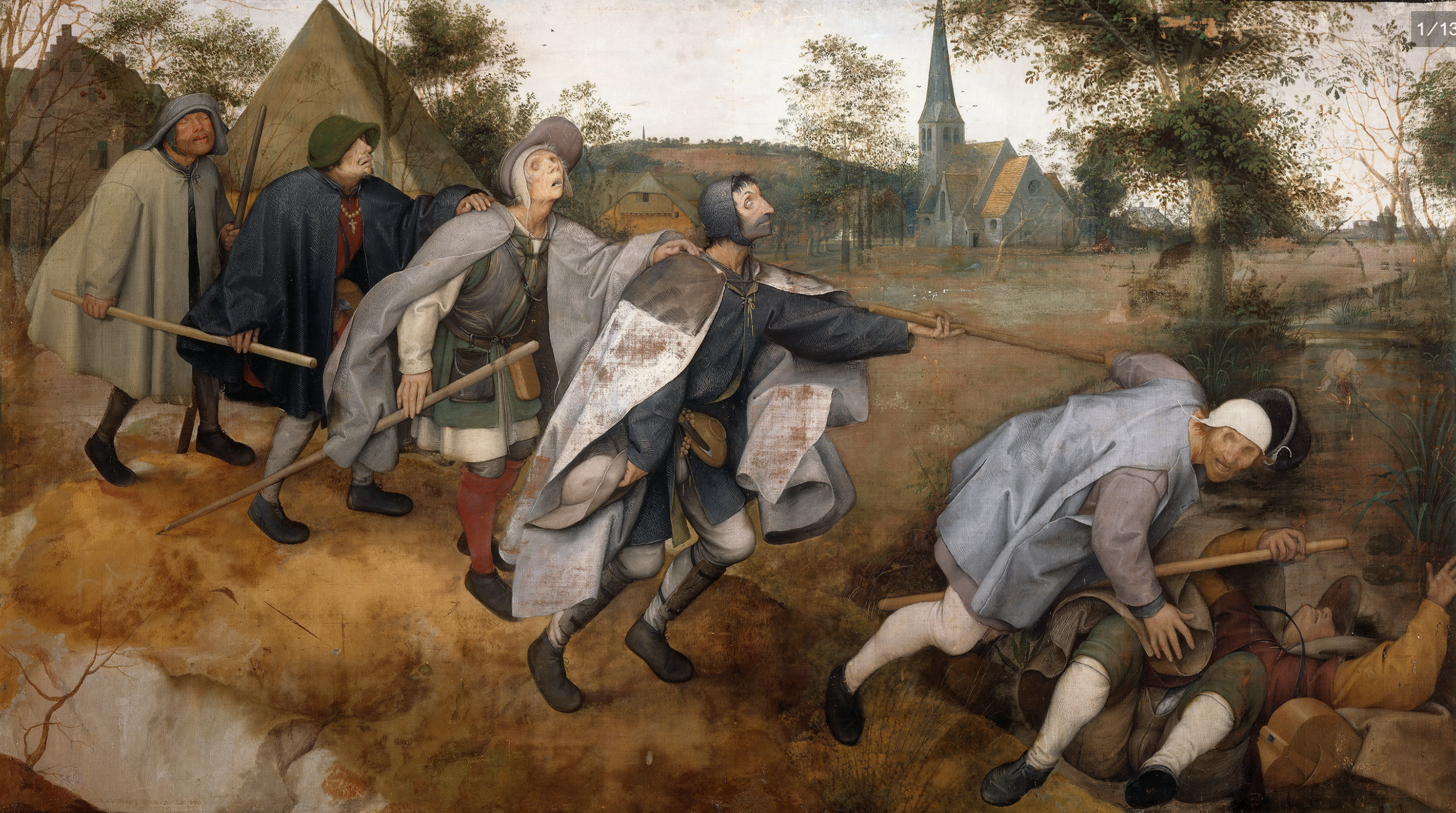
In 1568, Pieter Bruegel the Elder painted The Blind Leading the Blind, a work so disturbing and poetic that it still echoes through centuries of moral reflection.
Six blind men walk in a diagonal line through a barren landscape, each grasping the shoulder or staff of the one before him. The first has already fallen into a ditch; the rest will follow.
This composition transforms a proverb from the Gospel of Matthew (15:14) — “If the blind lead the blind, both shall fall into the ditch” — into a chilling allegory of spiritual blindness, human arrogance, and collective folly.
Housed today in the Museo di Capodimonte in Naples, the painting is both a technical marvel and a theological sermon without words.
(Museo di Capodimonte Official Page)
The Parable Reimagined
Bruegel’s The Blind Leading the Blind was painted at the end of his life, when the Netherlands was gripped by religious division and political upheaval.
It’s no coincidence that the painter chose a parable about misguided faith — a subject that could criticize both church and society without naming either.

The six blind men are not caricatures; they are individuals.
Each face is etched with incredible detail — wrinkled skin, hollow eyes, and open mouths caught mid-breath.
Bruegel gives blindness not as absence but as presence, an active force leading humanity astray.
This tension between moral decay and divine silence recalls Rembrandt’s introspective spirituality in The Return of the Prodigal Son (1669).
But where Rembrandt finds redemption, Bruegel finds warning.
Composition – The Diagonal of Doom
The figures march from upper left to lower right, forming a cascading diagonal that mimics both a procession and a fall.
The first man tumbles into the pit, his pole snapped like faith itself; the second leans helplessly forward; the others freeze in stages of shock and collapse.
The entire motion feels inevitable — once begun, it cannot stop.

Art historians at The Metropolitan Museum of Art note that Bruegel’s use of perspective amplifies the sense of destiny.
The landscape is calm — a church steeple rises in the distance, symbolizing faith — but the human figures, meant to embody that faith, have lost their way.
It’s not just physical blindness; it’s moral disorientation.
Bruegel captures the moment when sight fails, but pride continues walking.
Faith, Folly, and Renaissance Irony
The Renaissance celebrated reason, anatomy, and perspective.
Yet Bruegel, often called the “peasant philosopher,” turned these ideals inside out.
He used technical perfection to expose spiritual imperfection.
His blind men are anatomically precise — even their diseased eyes are medically accurate, as confirmed by studies from the Journal of the Royal Society of Medicine.
But this accuracy serves irony: science cannot save them from moral blindness.
The result is what scholars call “compassionate satire” — Bruegel mocks, but with sorrow.
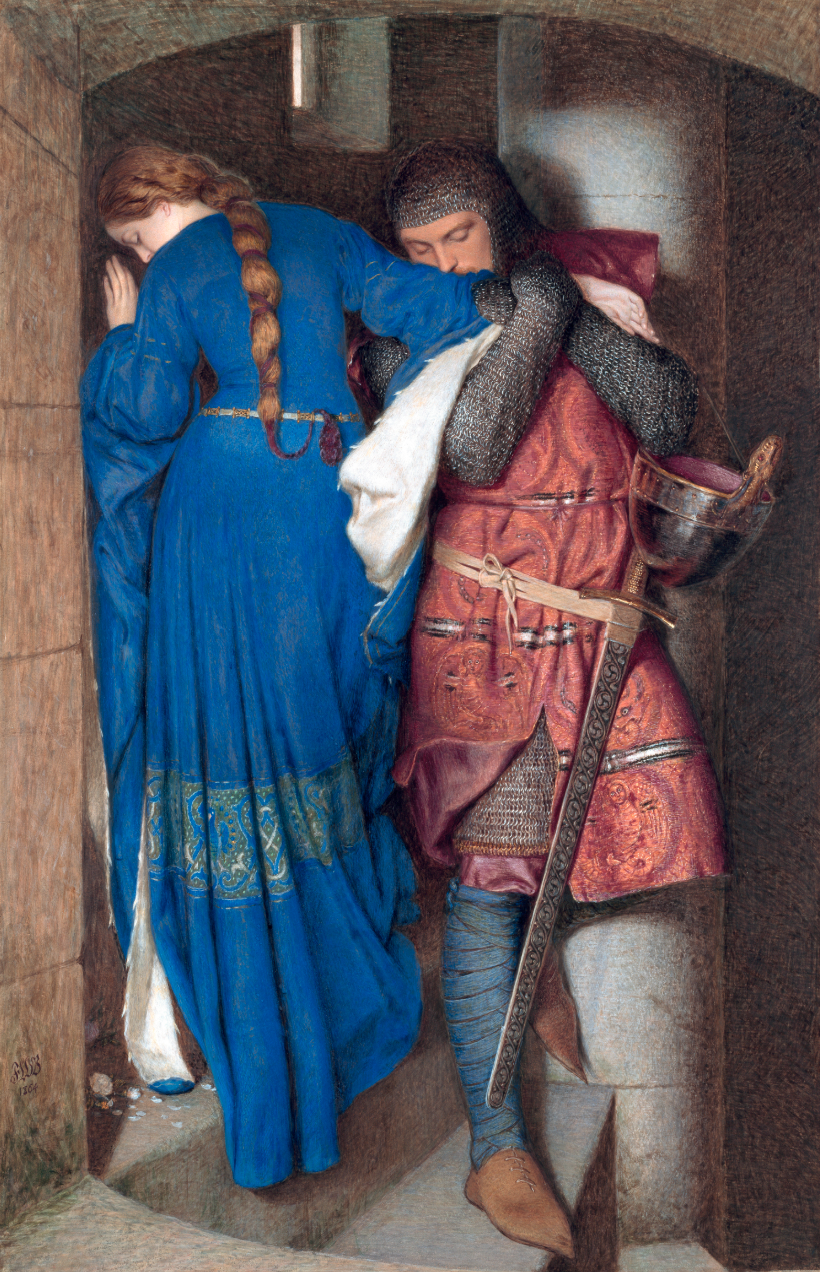
It’s the same moral weight felt in The Broken Vows (1856), where passion and betrayal lead to ruin.
In both, the artists portray a world where human vision — literal or moral — is never complete.
Light, Earth, and Shadow
Bruegel’s palette is subdued — ochres, greys, and soft greens — yet his control of tone gives the painting a sculptural gravity.
The men’s robes ripple like earth itself; they seem carved from the same clay they stumble upon.
Light falls from the left, but it does not illuminate; it reveals futility.
The irony of divine light failing to save them echoes through religious art history — just as in The Raising of Lazarus (1630), light becomes a symbol of resurrection.
Bruegel, however, paints a darker theology: when faith loses awareness, illumination becomes irrelevant.
This moral chiaroscuro aligns him with Hieronymus Bosch, whose chaotic visions influenced Bruegel’s early work.
(National Gallery – Pieter Bruegel Biography)
A Study in Human Fragility
Every figure in The Blind Leading the Blind expresses a stage of downfall — confidence, shock, resistance, despair.
They are not villains but participants in their own tragedy.
The man at the end still walks with purpose, unaware of the chaos ahead.
This human vulnerability makes the painting universal.
As critic Svetlana Alpers wrote, “Bruegel paints humanity not as sinners, but as sleepers.”
It’s a quiet tragedy, not divine punishment.
Modern viewers recognize the same pattern today — societies following false certainties, guided by echo chambers instead of truth.
Bruegel’s message remains painfully current: without self-awareness, even knowledge becomes blindness.
Technical Mastery and Innovation
Though Bruegel often worked in oil on wood, his technique here approaches a new realism.
The six figures occupy precise intervals, creating rhythm within chaos.
Their canes, garments, and gestures repeat like a tragic refrain.
Scholars at The Art Institute of Chicago emphasize that Bruegel’s genius lies in empathy — he renders suffering without spectacle.
The viewer becomes witness, not voyeur.
That compassion links Bruegel to later Northern masters like Rembrandt and Vermeer, who found holiness in humility rather than grandeur.
From Parable to Philosophy
While inspired by scripture, The Blind Leading the Blind transcends theology.
It’s a reflection on leadership, ignorance, and faith without understanding.
In Bruegel’s time, Europe was splitting between Protestant and Catholic powers — both claiming divine truth, both blind to compromise.
By using a biblical proverb as allegory, Bruegel exposed fanaticism without heresy.
It’s the same human dilemma Rembrandt painted a century later — to see divinity not in dogma but in mercy, as shown in The Return of the Prodigal Son (1669).
Both artists warn us: without empathy, belief becomes blindness.
The Church in the Distance – Hope or Irony?
One of the most debated details in the painting is the church in the far distance.
Does it represent salvation waiting to be found, or the hypocrisy that led the men astray?
The church steeple, precisely painted, stands upright while the men collapse diagonally beneath it — geometry as morality.
Bruegel’s genius lies in this duality: the symbol of faith remains untouched, yet its followers are broken.
This subtle critique reflects the intellectual climate of 16th-century Flanders — a region wrestling with faith and rebellion.
(Smarthistory Analysis – Bruegel’s The Blind Leading the Blind)
The Lesson of the Blind
Ultimately, The Blind Leading the Blind is not pessimistic; it’s awakening art.
It urges humility — a call to open not our eyes, but our conscience.
Bruegel’s peasants are not fools but reflections of ourselves, walking confidently into uncertainty.
In that sense, this painting shares the same emotional humanity as the subjects in The Broken Vows (1856) — people who believe they see clearly until truth humbles them.
Bruegel’s timeless insight: vision without wisdom is the deepest darkness.
Why It Still Resonates
Five centuries later, The Blind Leading the Blind feels uncannily modern.
Its message transcends religion, politics, and art history.
In a world overflowing with information, the painting warns of following without seeing, believing without understanding.
This is why art remains vital — it restores sight where noise has blinded us.
Bruegel’s humble peasants remind us that awareness, not certainty, is the beginning of wisdom.
FAQ – The Blind Leading the Blind (1568)
What is the meaning of The Blind Leading the Blind?
The Blind Leading the Blind by Pieter Bruegel the Elder illustrates a biblical proverb from Matthew 15:14: “If the blind lead the blind, both shall fall into the ditch.” The painting depicts six blind men walking in a line, each guided by the one ahead. When the leader falls, the rest inevitably follow. Bruegel uses this image as a warning about spiritual blindness, moral arrogance, and misguided faith. Rather than mocking disability, he exposes how pride and ignorance lead entire societies astray — a timeless reflection on false leadership and collective folly.
Why is The Blind Leading the Blind considered a masterpiece?
The Blind Leading the Blind is hailed as one of the greatest works of Northern Renaissance art because it combines meticulous realism with moral allegory. Every face shows a different moment of fear and collapse, painted with anatomical accuracy and compassion. Scholars at the Metropolitan Museum of Art note that Bruegel’s diagonal composition creates a rhythm of inevitable tragedy. His ability to turn a proverb into a visual philosophy — using light, movement, and empathy — makes the painting both intellectually profound and emotionally devastating.
Where can I see The Blind Leading the Blind in person?
The original The Blind Leading the Blind (1568) is housed at the Museo di Capodimonte in Naples, Italy. The painting, executed in tempera on panel, measures about 86 × 154 cm. Visitors can view it as part of the museum’s permanent Flemish collection, which also features other Renaissance masterpieces. The museum provides in-depth interpretation materials explaining the painting’s theological roots and Bruegel’s technique. You can explore its collection online through the Museo di Capodimonte official website.
What does the church in The Blind Leading the Blind symbolize?
In the background of The Blind Leading the Blind, a small church stands upright while the blind men stumble toward a ditch. This contrast is central to the painting’s symbolism. The church may represent faith and divine truth — unshaken and distant — or, conversely, the hypocrisy of institutions that claim vision yet fail to guide the faithful. Bruegel leaves the meaning ambiguous, forcing viewers to decide whether salvation is still possible or already lost. This tension between sacred stability and human error is what gives the painting its haunting power.
How does The Blind Leading the Blind relate to modern times?
Although painted in 1568, The Blind Leading the Blind feels strikingly contemporary. Its message about misinformation, blind obedience, and leadership without insight resonates in today’s world of social media and politics. Bruegel reminds us that progress without wisdom is still blindness. Like The Broken Vows (1856) and The Return of the Prodigal Son (1669), it transforms moral failure into reflection. The painting continues to warn and inspire, urging viewers to open their eyes — not only to see, but to understand.



Leave a Reply