
A Moment of Goodbye Frozen in Time
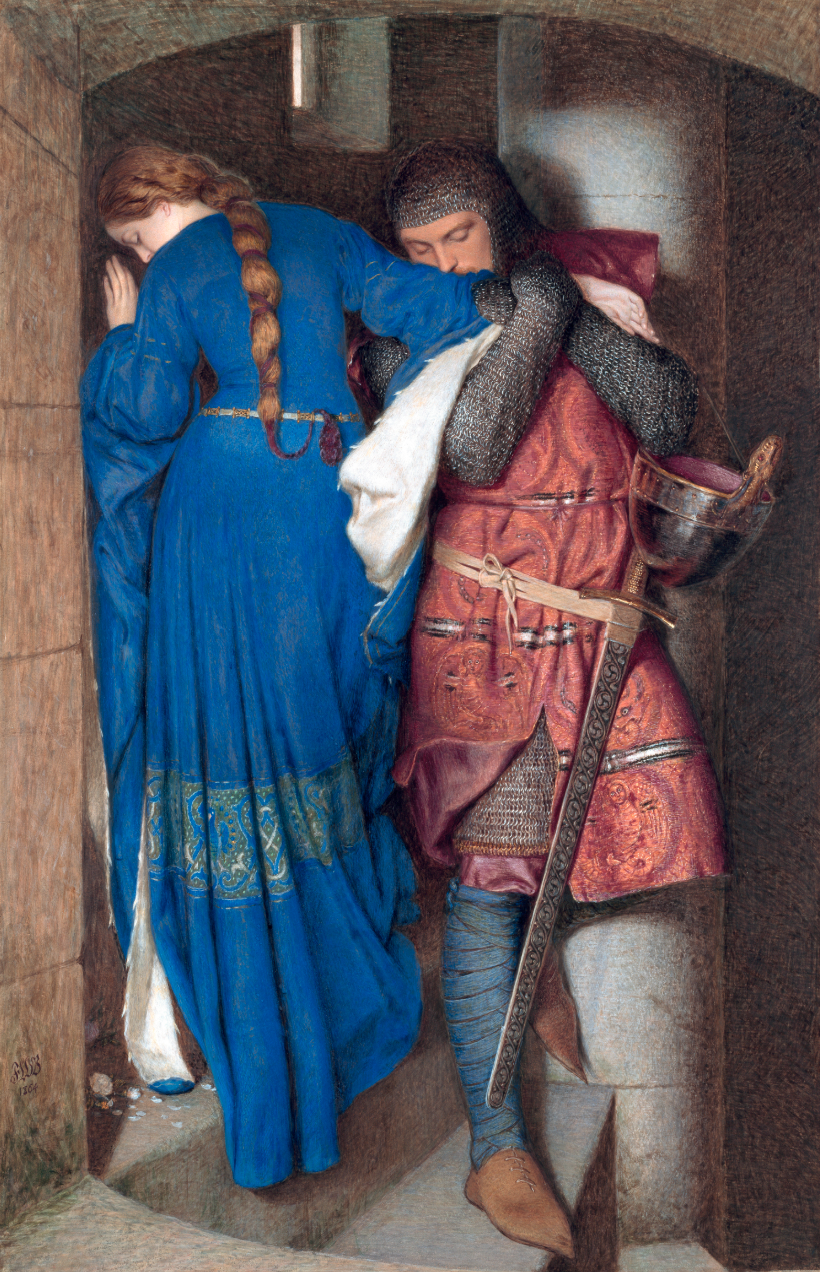
In 1864, Irish painter Sir Frederic William Burton transformed a medieval ballad into one of the most poignant watercolours of the Victorian age.
The Meeting on the Turret Stairs depicts a silent farewell — a princess ascending a narrow stone staircase, and the knight she can never love pressing a last kiss upon her arm.
Based on the 12th-century Danish legend Hellelil and Hildebrand, the story ends in tragedy: the princess’s brothers kill the knight for daring to love above his station. Burton chose not to paint the violence, but the instant before — a whisper between love and death.
Today, the painting hangs in the National Gallery of Ireland, where it was voted Ireland’s Favourite Painting in 2012 (National Gallery of Ireland).
Table of Contents
The Story Behind the Stairs
Burton (1816–1900) was known for miniatures and watercolour precision rather than oil painting.
In The Meeting on the Turret Stairs, he combined Pre-Raphaelite clarity with medieval restraint.
The result is a work of overwhelming tenderness: a study of love constrained by duty.

The turret staircase becomes more than architecture; it’s a symbolic boundary — the divide between worldly honour and private feeling.
She ascends — he remains. They meet halfway, only for a moment.
This emotional architecture echoes the sacred tension explored in The Return of the Prodigal Son (1669), where Rembrandt used light to bridge the gap between guilt and grace.
Both artists capture a moment when forgiveness and loss intersect — a gesture instead of a speech.
Composition and Symbolism
Burton’s painting measures 95.5 × 60.8 cm and is rendered in watercolour and gouache on paper.
The scene is tightly cropped, the staircase spiralling behind them into shadow.
Her blue robe, detailed with gold threads, signifies purity and nobility; his red armour gleams with blood-coloured devotion.

As The Victorian Web notes, Burton drew upon miniature technique — each fold of fabric, each reflection meticulously applied in thin layers to achieve oil-like depth.
Yet he avoids the melodrama of 19th-century romance; his figures whisper where others would cry.
The painting’s restraint recalls the silent sorrow of The Broken Vows (1856), another BrushBows-featured work where love and moral conflict collide in a single gesture.
In both, emotion exists in stillness — not movement.
Colour and Light – Emotions in Watercolour
Burton mastered the impossible: to make watercolour burn with the intensity of oil.
The entire palette is confined to muted blues, bronzes, and reds.
According to Chasing Art Blog, this delicate limitation heightens the viewer’s empathy — we feel the hush before heartbreak.
Light flows diagonally from the top left, touching her hair and his armour before vanishing into shadow.
It’s not illumination but remembrance — as if the artist painted light from memory.
Such inner radiance connects this piece spiritually with The Raising of Lazarus (1630), where Rembrandt revived not just a body but the human capacity for hope.
Burton’s light does the same through love instead of faith.
The Unspoken Farewell
No words are exchanged.
He bends; she leans away. His kiss on her arm becomes a prayer.
The movement is minute but monumental. It is the entire relationship compressed into a single gesture.
Writer George Eliot admired this painting for its “intense refinement of feeling.” Indeed, Burton’s discipline prevents sentimentality — he lets colour speak where words would fail.
Art historians at the Metropolitan Museum of Art have called it one of the finest examples of narrative minimalism in Victorian watercolour.
The intimacy of touch also mirrors Rembrandt’s humanism: light as mercy, gesture as forgiveness.
But Burton’s love is earthbound — it does not redeem; it remembers.
Cultural and Emotional Context
When The Meeting on the Turret Stairs was first exhibited at the Old Watercolour Society in London, critics were divided.
Some found it too still; others called it a masterpiece of restraint.
Over time, it became a national treasure in Ireland and a prototype for sentimental symbolism across Europe.
The painting also illustrates how Victorian artists used historical romance to explore modern psychology.
Burton was not telling a medieval tale so much as examining the ethics of emotion — what it means to feel deeply yet behave honourably.
For contemporary viewers, this moral tension feels as relevant as ever — love versus duty, emotion versus expectation.
Even today, as seen in Wikipedia’s entry, Burton’s painting is studied for its psychological precision and subdued eroticism.
Parallel Visions of Love and Loss
Placed within the BrushBows canon, Burton’s work stands beside Rembrandt and Calderon as a triad of emotion and faith.
Where Rembrandt’s The Return of the Prodigal Son offers reconciliation through grace, and Calderon’s The Broken Vows portrays betrayal through symbol, Burton’s Turret Stairs captures the moment before both — the instant when love turns into memory.
Each work in this sequence shows a different phase of human emotion: sin, repentance, farewell.
Together they form a continuum of feeling that defines BrushBows’ mission — to reveal the sacred within the secular, the eternal within the momentary.
Why It Still Matters
In a digital age obsessed with speed and confession, Burton’s painting reminds us that silence can be revolutionary.
The stillness between the two figures is not emptiness — it’s the weight of everything they cannot say.
It teaches us that art doesn’t need to shout to be heard.
Sometimes a whisper on a turret staircase outlasts a lifetime of words.
This is why the painting continues to inspire modern storytellers and filmmakers.
As noted by the National Gallery of Art Washington, Burton’s subtle colour and emotional discipline helped define the ethics of Victorian watercolour — art as restraint, feeling as form.
Art as Devotion
Burton never married. His life was quiet, devout, and dedicated to art.
For two decades he served as Director of the National Gallery in London, acquiring masterpieces that shaped modern taste.
But it is this painting — small, intimate, and wordless — that became his immortality.
Viewed alongside Rembrandt’s religious dramas like The Raising of Lazarus, Burton’s work transfers faith from the divine to the human.
It is the religion of touch, the sacrament of farewell.
Conclusion – The Silence That Speaks
The Meeting on the Turret Stairs remains one of the most haunting love stories ever painted.
Every curve of the stair, every fold of fabric, and every flicker of light speaks of restraint and devotion.
Burton reminds us that some of the greatest romances end not in union, but in understanding.
In this painting, the space between two people is holy ground.
And perhaps that is why we cannot look away.
FAQ – The Meeting on the Turret Stairs (1864)
What is the story behind The Meeting on the Turret Stairs?
The Meeting on the Turret Stairs is based on the tragic Danish ballad of Hellelil and Hildebrand, a princess and her guard who fall in forbidden love. When her brothers discover the affair, they order Hildebrand’s death. Frederic William Burton chose to depict not the violence but the quiet farewell — a fleeting moment on a spiral stairway where the knight kisses her arm before his fate. This subtle gesture captures the eternal human conflict between love and duty, restraint and passion, making the painting one of the most emotional narratives in Victorian art.
Why is The Meeting on the Turret Stairs considered Burton’s masterpiece?
Among Frederic William Burton’s works, The Meeting on the Turret Stairs stands out for its emotional precision and technical mastery. Burton, known for miniature painting, achieved near-oil depth using only watercolour and gouache. Critics admire how he transforms stillness into drama, light into feeling. Instead of theatrical gestures, he uses colour, shadow, and proximity to communicate heartbreak. The result is a painting that balances spiritual restraint with raw emotion — the hallmark of a true masterpiece and one reason it was voted Ireland’s Favourite Painting by the National Gallery of Ireland.
What does The Meeting on the Turret Stairs symbolize?
Symbolically, The Meeting on the Turret Stairs represents love constrained by social order. The turret stair itself acts as a border between the spiritual and the physical world — she ascends toward duty, while he remains bound to passion. The blue of her gown signifies loyalty and purity, while his red armour evokes courage and sacrifice. Together they embody the impossible balance between devotion and obedience. Burton’s restrained palette and composition remind viewers that true love often exists most powerfully in silence, restraint, and memory.
Where can I see The Meeting on the Turret Stairs in person?
The Meeting on the Turret Stairs is housed at the National Gallery of Ireland in Dublin, where it has been part of the national collection since 1898. Visitors can view the painting in the museum’s highlights gallery, accompanied by contextual information on the Danish legend that inspired it. The work remains one of Ireland’s most celebrated treasures, frequently featured in art history exhibitions and university studies on Victorian watercolour technique and emotional realism. For more background, the National Gallery of Ireland’s official page offers further insights.
How does The Meeting on the Turret Stairs compare to other romantic artworks?
The Meeting on the Turret Stairs shares emotional DNA with other BrushBows-featured works like The Broken Vows (1856) and The Return of the Prodigal Son (1669). Each portrays love and loss through restraint rather than spectacle. While Calderon and Rembrandt explore forgiveness and moral conflict, Burton focuses on the moment before separation, capturing heartbreak through tenderness. His watercolour approach and minimalism give the scene a timeless grace that continues to resonate with modern audiences seeking quiet, enduring emotion in art.




Leave a Reply