
Executive Insight
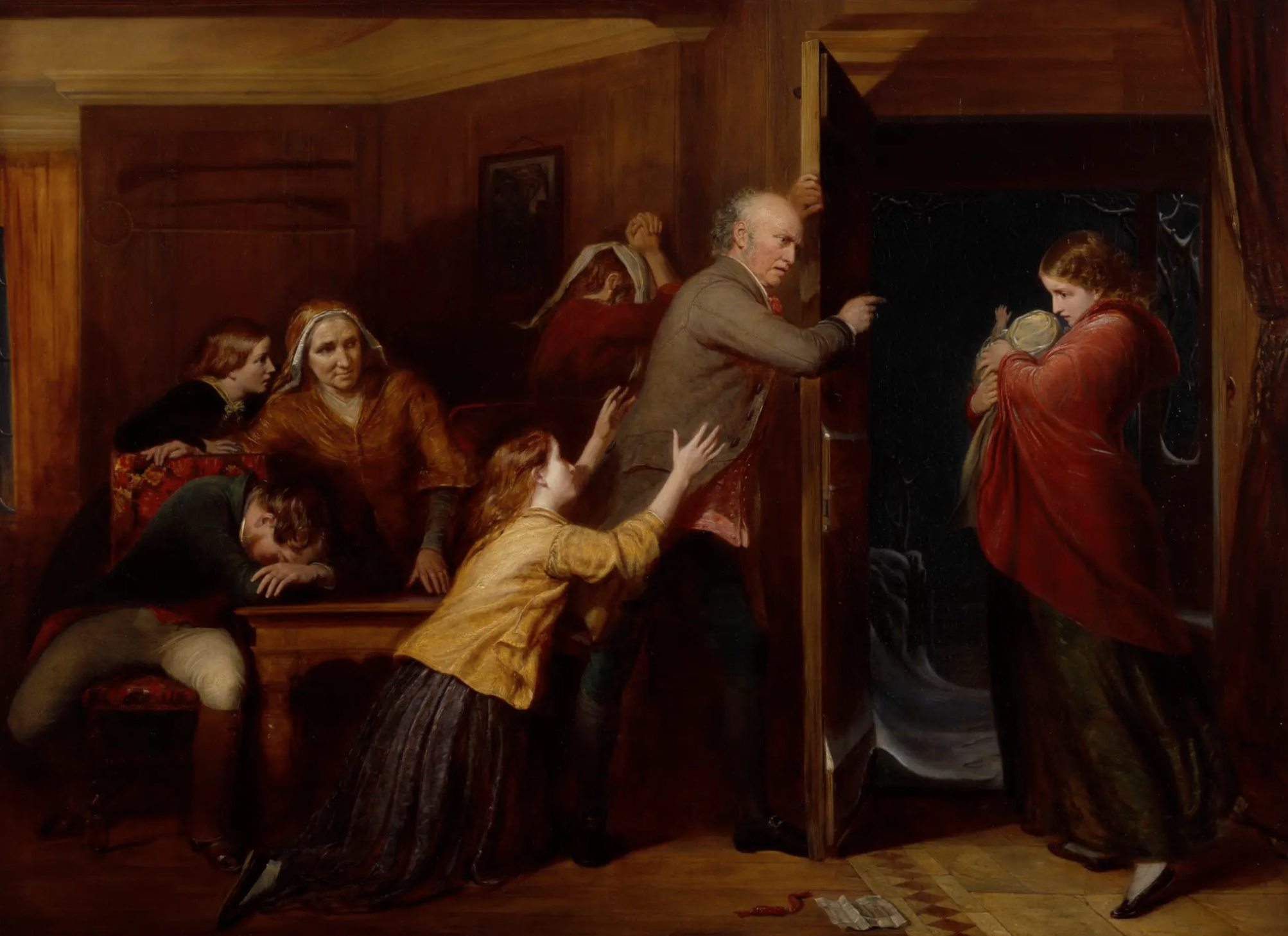
Richard Redgrave’s The Outcast (1851) stands as one of the most haunting moral dramas of the Victorian era — a frozen moment where love, judgment, and redemption collide. The painting shows a father expelling his daughter, who carries an infant in her arms, while the rest of the family watches in silence. It’s a story not about sin, but about the social cruelty of moral perfectionism.
Much like in The Awakening Conscience, Redgrave invites the viewer to witness the moral theatre of 19th-century domestic life — a world that values reputation over compassion. His work became a mirror of the era’s conscience, a warning about what happens when faith loses empathy.
Table of Contents
1. The Story Behind The Outcast (1851)
Painted in 1851, at the height of Victorian moral rigidity, The Outcast (1851) captures a father disowning his daughter for an illegitimate child — a scene inspired by real moral tragedies of the time. The emotional contrast between the father’s cold command and the daughter’s quiet despair is staggering. The snow outside the door mirrors the moral frost within the home.
According to The British Library’s Victorian society archive, the “fallen woman” was a recurring theme across literature and art — yet few artists gave her humanity like Redgrave did. His brushstroke exposes not scandal, but sorrow.
2. Symbolism — Shadows of Judgment and Silence
Every object in The Outcast (1851) speaks in moral code. The Bible resting unopened on the table represents a religion unpracticed; the snow outside signals purity that excludes; the infant embodies innocence born into condemnation.
As analyzed by Victorian Web, Redgrave’s use of domestic interiors turns the family room into a courtroom. The artist weaponizes realism to confront hypocrisy — portraying a father whose gesture mimics divine justice, yet betrays divine compassion.

His method recalls Caravaggio’s moral chiaroscuro — the same tension seen in Judith Beheading Holofernes (1599), where faith and brutality intertwine. In both, illumination becomes accusation.
3. Redgrave’s Vision — Realism as Moral Reform
Richard Redgrave, a founding member of the Royal Academy, used art as moral activism. His mission was not to beautify life, but to expose its contradictions. In The Outcast (1851), he invites empathy toward those whom Victorian society deemed irredeemable.
The father’s face — frozen between authority and shame — reflects a broader societal blindness. For Redgrave, painting was a moral act; he believed compassion itself was revolutionary. His realism was reformist, meant to stir public debate rather than private admiration.
4. Victorian Hypocrisy and Redemption
The world of The Outcast (1851) is built on appearances — morality as performance. The mother’s posture, rigid and resigned, contrasts with the younger sister’s compassion, who kneels to plead for mercy. Redgrave intentionally divides the room into moral camps: law, indifference, and grace.
The painting serves as both social critique and emotional mirror. As National Gallery of Victoria notes, Victorian audiences were unsettled by Redgrave’s realism because it forced them to see the cost of their own virtues.

In contrast to The Calling of Saint Matthew, where divine light calls sinners inward, The Outcast (1851) shows light pushing the sinner out. Both stories reflect the same eternal question: can redemption exist without compassion?
5. Legacy — The Outcast (1851) in Modern Eyes
More than a century later, The Outcast (1851) still feels painfully current. Its theme — public shame and private suffering — reappears in the digital age. Cancel culture and moral absolutism echo Victorian judgment dressed in modern language.
As BBC Culture explores, the “fallen woman” motif became a symbol for systemic inequality, where repentance was never enough. Redgrave’s art exposes that same cycle — condemnation without compassion.
In today’s polarized world, The Outcast (1851) reminds us that grace is the rarest form of courage. Much like The Calling of Saint Matthew, its power lies not in the gesture, but in the moment of choice. Redgrave’s work endures because it doesn’t offer comfort — it demands conscience.
Bottom Line
Richard Redgrave’s The Outcast (1851) remains one of the most emotionally charged moral paintings in British art — a sermon in silence. At first glance, it appears to depict sin and punishment, but beneath that surface lies a deeper dialogue about empathy and redemption.
The painting’s stillness is deceptive. The father’s hand extends like a judge’s verdict, while the daughter clutches her child — her entire future held in trembling arms. Around them, each family member becomes a moral symbol: the mother as fear, the sister as mercy, the father as judgment, and the infant as innocence. Together they form the moral anatomy of a civilization convinced that shame equals salvation.
Redgrave’s The Outcast (1851) transforms domestic space into sacred theater. The snow outside, the stark doorway, the dim interior — every detail whispers of exile. The artist’s technique, influenced by realism, was revolutionary because it gave emotional life to the condemned. Rather than idealize virtue, he painted its consequences.
Much like Caravaggio’s The Calling of Saint Matthew, Redgrave constructs a visual argument about choice — but here, the calling is inverted. In Caravaggio’s work, Christ points inward, summoning a sinner toward redemption; in The Outcast (1851), a father points outward, casting his own child into isolation. Both moments define the fragile border between justice and mercy, yet only one contains grace.
This moral inversion is what makes The Outcast (1851) timeless. It forces the viewer to confront the cost of righteousness. Redgrave reminds us that a closed door is more tragic than a broken rule — that moral perfection without compassion becomes tyranny. His realism was prophetic, anticipating our own struggles with public shaming and self-righteousness.
In the modern era, The Outcast (1851) resonates beyond religion or morality — it touches psychology. It reflects every person who’s ever been exiled for imperfection, silenced for difference, or punished for honesty. It shows that redemption does not begin with apology; it begins when others choose forgiveness.
Ultimately, The Outcast (1851) is less a painting about sin than a painting about the failure to love. Redgrave’s message is quietly subversive: the true outcast is not the woman, but the world that rejects her.
And so the painting endures — not as a relic of Victorian repression, but as a timeless mirror of our own hearts.
FAQ
Q1. What is the main meaning of The Outcast (1851) by Richard Redgrave?
The Outcast (1851) depicts a Victorian father expelling his daughter for bearing an illegitimate child, symbolizing moral rigidity and lack of compassion in 19th-century society. Redgrave uses the scene to question whether moral judgment without empathy can truly be virtuous.
Q2. Why did Richard Redgrave paint The Outcast (1851)?
Redgrave painted The Outcast (1851) to expose the emotional cruelty of Victorian morality. He sought to reform society through realism — turning the domestic home into a stage for moral debate. His goal was not to condemn sin, but to provoke compassion.
Q3. What symbols appear in The Outcast (1851)?
The painting’s snow, Bible, and infant all carry symbolic meaning. The snow represents purity without warmth, the closed Bible symbolizes unpracticed faith, and the infant embodies innocence punished by hypocrisy.
Q4. How does The Outcast (1851) compare to The Calling of Saint Matthew?
Both The Outcast (1851) and The Calling of Saint Matthew center on moral choice. Caravaggio’s work depicts a divine invitation to grace, while Redgrave’s shows human rejection of grace. One welcomes the sinner; the other casts her away — two mirrors of redemption and exile.
Q5. Why is The Outcast (1851) still relevant today?
In modern culture, The Outcast (1851) resonates as a reflection on cancel culture and public shaming. Redgrave’s message is timeless: without empathy, morality becomes cruelty. The painting challenges viewers to replace judgment with understanding — a theme echoed in Judith Beheading Holofernes (1599), where moral action walks a fine line between justice and violence.




Leave a Reply