
A Duel Without Glory
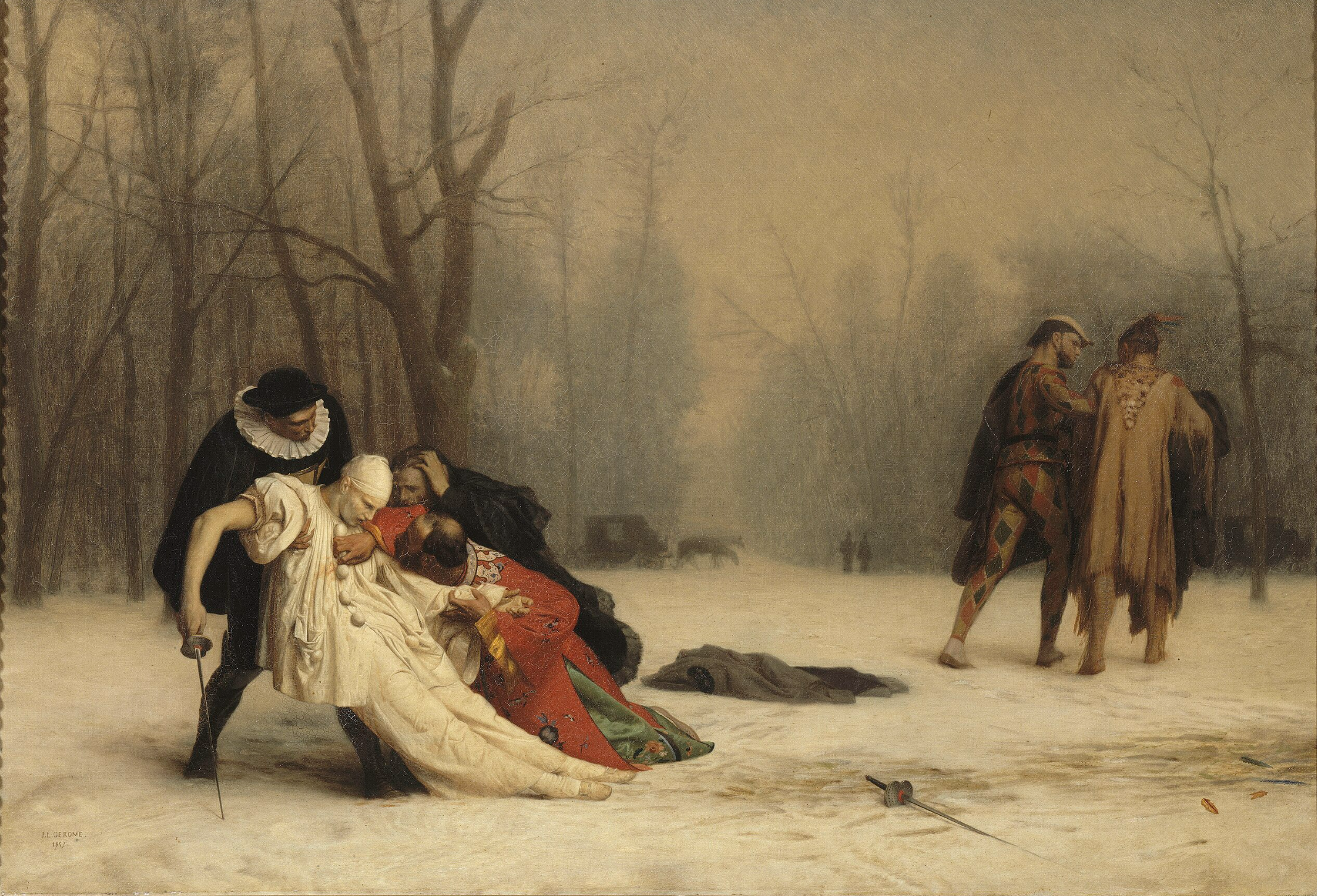
In the still, grey light of early morning, a man walks away from his opponent — his cloak stained with blood. Behind him, the fallen figure of another duelist lies crumpled on the snow while two seconds rush forward.
This is the chilling scene that French academic painter Jean-Léon Gérôme immortalized in After the Duel (1857–1859), one of the most emotionally complex paintings of the 19th century.
Painted at the height of the Romantic fascination with honor culture, Gérôme’s work depicts not the duel itself, but its melancholy aftermath. The thrill of combat has passed; what remains is silence, guilt, and the cold.
The painting is now held at the Walters Art Museum in Baltimore (Walters Art Museum Collection) and stands as one of Gérôme’s earliest masterpieces of narrative realism.
The Scene – Blood on Snow
Set in the outskirts of Paris’s Bois de Boulogne, the painting captures the moment immediately following a pistol duel between two men of high society.
The victor, still clutching his weapon, is escorted by a friend draped in a cloak of rich blue and red — the colors of the Commedia dell’Arte costume of Pierrot, a character known for innocence and melancholy.

The defeated man lies motionless in the snow, his face pale beneath the morning fog. The traces of red blood against white ground turn the scene into an allegory of conscience.
The quietness is unbearable — no cheers, no triumph, only the aftermath of pride.
As Gérôme scholar Gerald Ackerman observed, “the painting shows not heroism, but the emptiness that follows it.”
(The Art Story)
Honor and the Theater of Death
Gérôme’s fascination with ritual, costume, and stage-like settings gives After the Duel a theatrical dimension.
The victor’s outfit, borrowed from the commedia Pierrot, turns him into a tragic clown — a man who fought for pride and found sorrow.

This theatrical irony recalls the emotional symbolism of The Broken Vows (1856), where love becomes betrayal under a sacred oath.
In both, outer appearances — dueling attire, marriage vows — hide deep psychological fracture.
Critics at the Salon of 1857 praised Gérôme’s cinematic storytelling. His meticulous realism made viewers feel the frost, the shock, the shame.
(Musée d’Orsay Archives)
The Romantic Cult of the Duel
During the mid-19th century, dueling was both illegal and fashionable.
Among aristocrats and artists, it was seen as a “necessary fiction” — a ritual to defend honor even when reason forbade it.
Gérôme’s choice to depict the moment after rather than during the duel reflects his moral detachment.
Unlike the dramatic canvases of Delacroix or Géricault, After the Duel avoids motion. It is psychological, not heroic.
This moral stillness mirrors Rembrandt’s quiet redemption scenes in The Return of the Prodigal Son (1669), where emotion resides in gesture, not spectacle.
Both artists transform action into spiritual reflection.
Light, Composition, and Silence
The composition leads the eye diagonally across the canvas — from the fallen body to the departing victor.
Snow covers everything, muting color and sound. The cold light of dawn gives the scene a near-photographic realism.
According to the Metropolitan Museum of Art, Gérôme’s mastery of light comes from his study of sculpture and perspective.
The duelists are not framed as villains or heroes; they are performers trapped in the ritual of masculinity.
Snow and blood function symbolically — purity and violence intertwined.
The red stains echo the wounds of conscience: once spilled, they can’t be undone.
The Pierrot – Tragedy in White
The victor’s Pierrot costume carries psychological depth.
In French theater, Pierrot is a clown who loves sincerely but loses everything.
By dressing the duelist in this costume, Gérôme suggests that behind every act of “honor” lies vulnerability and foolishness.
This visual irony turns the painting into a quiet moral fable:
Even in victory, the Pierrot bleeds.
Gérôme’s contemporaries saw in it a critique of male vanity and performative honor, themes that still resonate in modern social culture.
(The Victorian Web)
Emotional Realism and Academic Precision
While Gérôme is often classified as an “academic painter,” After the Duel reveals the emotional power beneath his discipline.
Every gesture, shadow, and reflection is deliberate.
His realism does not glorify violence — it exposes the emotional void it leaves behind.
This precision links Gérôme to Rembrandt’s psychological empathy in The Raising of Lazarus (1630).
Both artists use light to expose revelation: Rembrandt’s divine awakening versus Gérôme’s moral awakening.
The frozen landscape acts like a conscience — silent, reflective, unforgiving.
The Audience as Witness
Gérôme often positioned viewers as outsiders, silently observing private moments.
In After the Duel, we are neither judge nor participant; we stand between pity and horror.
This technique anticipates cinematic realism.
Viewers can almost feel the crunch of snow beneath boots, the thin breath of winter air.
By excluding movement, Gérôme forces us to question our fascination with violence — why do we watch? why do we glorify?
In this way, the painting critiques both dueling and spectatorship.
The Universality of Shame
Though deeply rooted in 19th-century France, the moral of After the Duel transcends time.
The painting reveals that every “win” earned through pride carries a cost — isolation, guilt, and silence.
The victor walks away alive, yet spiritually wounded.
This emotional aftermath parallels the remorse and reconciliation explored in The Return of the Prodigal Son (1669).
Where Rembrandt painted forgiveness, Gérôme painted self-condemnation.
Both portray what comes after sin — the stillness where moral truth begins.
Influence and Legacy
After the Duel marked Gérôme’s transition from neoclassical myth to contemporary realism.
It paved the way for later narrative painters who sought truth in modern life — from Manet’s realism to early cinematic framing.
The painting’s moral resonance endures because its message is universal: honor without empathy is hollow.
Even today, Gérôme’s Pierrot figure echoes in literature and film — from modern antiheroes to tragic clowns who carry invisible guilt.
(The National Gallery of Art – Gérôme Biography)
Why It Still Matters
In an age obsessed with reputation, Gérôme’s After the Duel remains deeply relevant.
It questions the social rituals that justify violence and ego.
Its frozen silence speaks louder than the gunshot we never hear.
For BrushBows readers, this painting joins a lineage of works exploring remorse, redemption, and restraint — themes seen across The Broken Vows and The Return of the Prodigal Son.
Ultimately, After the Duel reminds us that victory without compassion is the most tragic defeat of all.
FAQ– After the Duel (1857–1859)
What is the story behind After the Duel by Jean-Léon Gérôme?
After the Duel portrays the silent aftermath of a pistol duel fought on the snowy outskirts of Paris. A wounded man lies on the ground while the victor, dressed as the melancholic Pierrot, walks away with his companion. Gérôme chose to show the consequences rather than the action itself—transforming what could have been heroic into a meditation on remorse, honor, and human pride. Inspired by 19th-century French “honor culture,” the work reveals how violence leaves no true winners, only emotional and moral scars.
Why is After the Duel considered one of Gérôme’s masterpieces?
After the Duel is widely regarded as Gérôme’s breakthrough into psychological realism. Critics praise its cinematic composition, subtle lighting, and moral tension. The snowy landscape absorbs sound and color, isolating the surviving duelist in guilt rather than glory. By focusing on the moment after violence, Gérôme broke with Romantic heroism and anticipated modern realism. The painting’s emotional precision, academic technique, and theatrical symbolism make it a cornerstone of 19th-century French art and a timeless reflection on conscience.
What does the Pierrot costume symbolize in After the Duel?
The surviving duelist’s Pierrot costume—white with traces of red—comes from the commedia dell’arte tradition, where Pierrot is the innocent fool and tragic lover. Gérôme uses this imagery ironically: the man who sought honor becomes a clown of his own vanity. The costume transforms the duel into a stage play about pride, hypocrisy, and remorse. Through Pierrot, After the Duel questions the very idea of masculine honor, exposing it as performance rather than virtue—a theme that resonates far beyond the 19th century.
Where can I see After the Duel today?
After the Duel is part of the permanent collection at the Walters Art Museum in Baltimore, Maryland. Visitors can view it among Gérôme’s other works exploring narrative realism and historical storytelling. The painting is frequently discussed in academic exhibitions on moral symbolism and 19th-century French art. High-resolution images and curatorial essays are available on the museum’s official site: Walters Art Museum – After the Duel.




Leave a Reply