
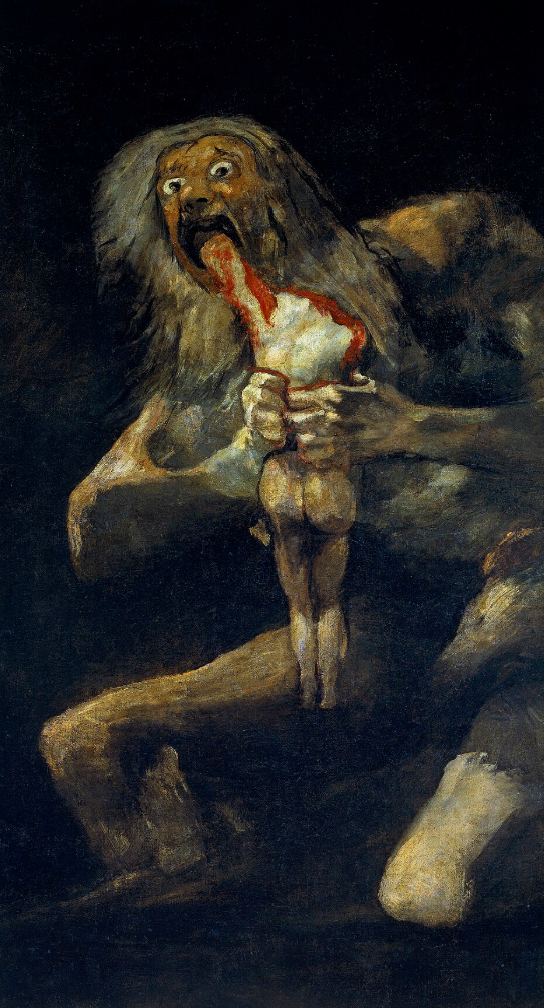
For over 200 years, this painting has haunted viewers. Some couldn’t sleep after seeing it; others admit the image never left their minds.
At first, it seems like just another old canvas. But look closer—and you’ll face one of the top 3 scariest paintings in the world.
The Journey Through Saturn Devouring His Son
Introduction: When Art Terrifies
What’s the most disturbing painting you’ve ever seen?
Art history is filled with beauty, elegance, and refinement—but also with moments when artists dared to paint the unthinkable. These works don’t merely please the eye; they unsettle the soul. Among them, Francisco Goya’s Saturn Devouring His Son consistently ranks as one of the top 3 scariest paintings in the world.
Hanging today in Madrid’s Museo del Prado, this haunting canvas depicts a mythological father who, driven by fear of prophecy, devours his own child. But the story of this painting is not just about mythology—it is about Goya’s own descent into darkness, Spain’s turbulent history, and the universal fears that still resonate with us today.
The Painting at a Glance

- Title: Saturn Devouring His Son (Saturno devorando a su hijo)
- Artist: Francisco Goya (1746–1828)
- Date: c. 1819–1823
- Medium: Oil on plaster (later transferred to canvas)
- Size: 143 × 81 cm
- Current Location: Museo del Prado, Madrid
Originally painted directly on the walls of Goya’s home, known as the Quinta del Sordo or “House of the Deaf Man,” Saturn belongs to the group of works we now call the Black Paintings. Unlike his earlier commissions, these paintings were private—never meant for public eyes. That secrecy alone gives them an unsettling intimacy, as if Goya painted not for us, but for himself, trapped in his own spiraling mind.
For more background, the Prado Museum provides a comprehensive history of the Black Paintings here.
Why It’s Among the Top 3 Scariest Paintings
1. A Myth Turned into a Horror Scene
In Roman mythology, Saturn (the equivalent of Cronus in Greek myth) feared a prophecy that one of his children would overthrow him. To prevent this fate, he devoured his offspring at birth. Most classical depictions of this myth retain some distance or allegory—majestic statues, symbolic frescos, or stylized drawings.

But Goya strips away allegory. His Saturn is not divine, but monstrous. His eyes bulge with madness; his hands clutch torn flesh; his mouth is smeared with blood. What should feel mythological feels immediate, brutal, and terrifyingly human.
Viewers often describe the experience of seeing this painting as witnessing a nightmare that has stepped into daylight. It doesn’t feel like mythology—it feels like cannibalism in real time.
2. Goya’s Darkness and Spain’s Turmoil
To understand this painting, you must understand Goya himself.
By the time he painted the Black Paintings, Goya had lived through:
- The Napoleonic Wars and the atrocities of occupation.
- The collapse of Spain’s monarchy and bitter civil unrest.
- His own deafness, which left him isolated in silence.
- Illness, depression, and despair.

Once celebrated as a royal court painter, Goya withdrew into solitude. In his home, away from patrons and commissions, he painted directly onto the plastered walls of his dining room and sitting areas—grim images of witches, demons, violence, and despair.
Art historians often argue that Saturn is as much about Goya himself as it is about mythology. Was Saturn’s paranoia a metaphor for Spain’s rulers clinging to power? Or was it a reflection of Goya’s own fear of mortality and madness? Either way, the painting pulses with more than myth—it pulses with lived trauma.
For deeper analysis of the Black Paintings, see The Art Story’s overview.
3. Why It Still Feels Terrifying Today
More than 200 years later, why does Saturn remain terrifying? The answer lies in its universal themes.
- Fear of Power Lost: Saturn devours his children to preserve his throne. How many leaders across history have destroyed their own people out of fear of being overthrown?
- Fear of Death: Cannibalism becomes a metaphor for mortality itself—a body consumed by time.
- Fear of Madness: Saturn’s expression isn’t triumphant, it’s deranged. The true horror may not be what he’s doing, but what he’s become.
This combination of political allegory, psychological realism, and raw brutality ensures that Saturn still chills us more than any polished horror film could. As Psychology Today has noted, Goya’s work still terrifies because it taps into “universal, timeless anxieties” (source).
If you’ve ever been captivated by the hidden skull in Holbein’s The Ambassadors (read here) or the nightmarish vision in Fuseli’s The Nightmare (explored here), then Goya’s Saturn will feel like their even darker sibling: raw, grotesque, and unforgettable.
The Black Paintings: A Window into Goya’s Mind
Saturn Devouring His Son is only one of 14 murals that comprised Goya’s Black Paintings. Others included Witches’ Sabbath, The Dog, and Two Old Men Eating Soup. Each carried the same heavy atmosphere—distorted faces, muted palettes, and haunting imagery.
These works were never signed, titled, or exhibited in Goya’s lifetime. They were personal exorcisms. He painted them in private, with no apparent intention of selling or displaying them. That secrecy, combined with their dark content, suggests Goya was painting his nightmares directly onto the walls of his home.
As Wikipedia’s entry on the Black Paintings explains, they were only transferred to canvas decades later, after Goya’s death (source).
Psychological Interpretations
Psychologists and scholars have offered varied interpretations of Saturn.
- Freudian: A manifestation of the death drive (Thanatos)—the self-destructive urge that lurks beneath human behavior.
- Political: Saturn as a metaphor for corrupt rulers who destroy their own people in fear of rebellion.
- Personal: A reflection of Goya’s declining health, deafness, and isolation, turning his inner despair into monstrous imagery.
Unlike allegorical mythological paintings, Goya’s Saturn refuses to remain symbolic. It feels personal and pathological. That’s part of its lasting terror: it feels like a painting of a mind unraveling.
From Myth to Modern Culture
Few paintings have echoed so widely in modern culture.
- Horror filmmakers borrow its imagery for posters and scenes.
- Writers reference Saturn as a symbol of madness and violence.
- Online communities continually debate whether it is “the scariest painting ever created.”
Alongside Fuseli’s The Nightmare and Holbein’s hidden skull in The Ambassadors, Goya’s Saturn completes a triad of works that challenge viewers to confront fear head-on.
Experiencing Saturn with Sound
Today, digital media has made Goya’s Saturn more accessible than ever. One powerful way to experience it is through video or short-form content paired with unsettling music.
Free, royalty-free options include:
- Kevin MacLeod’s Gathering Darkness (YouTube Audio Library)
- Dark Horror Suspense (Pixabay Music)
- Creepy Atmosphere (FreePD.com)
When paired with these sounds, the painting doesn’t just hang on a wall—it breathes, it pulses, it terrifies.
Conclusion: Why Saturn Stays With Us
Francisco Goya’s Saturn Devouring His Son isn’t just another mythological painting. It is a window into fear—political, psychological, and existential. It remains one of the Top 3 scariest paintings in the world because it forces us to confront what we often deny: the fragility of power, the inevitability of death, and the madness lurking beneath the surface of humanity.
Once you’ve seen it, you can’t unsee it. And maybe that’s the point.
FAQ
Q1. Who painted Saturn Devouring His Son?
Francisco Goya, around 1819–1823, as part of his Black Paintings.
Q2. Where is it located?
It is housed in the Museo del Prado, Madrid.
Q3. Why is it considered one of the scariest paintings?
Because it combines myth, psychological horror, and raw brutality in a way no other painting has before or since.
Q4. Is the painting in the public domain?
Yes, Goya’s works are public domain and can be reproduced freely.




Leave a Reply