
A World Ruled by Death
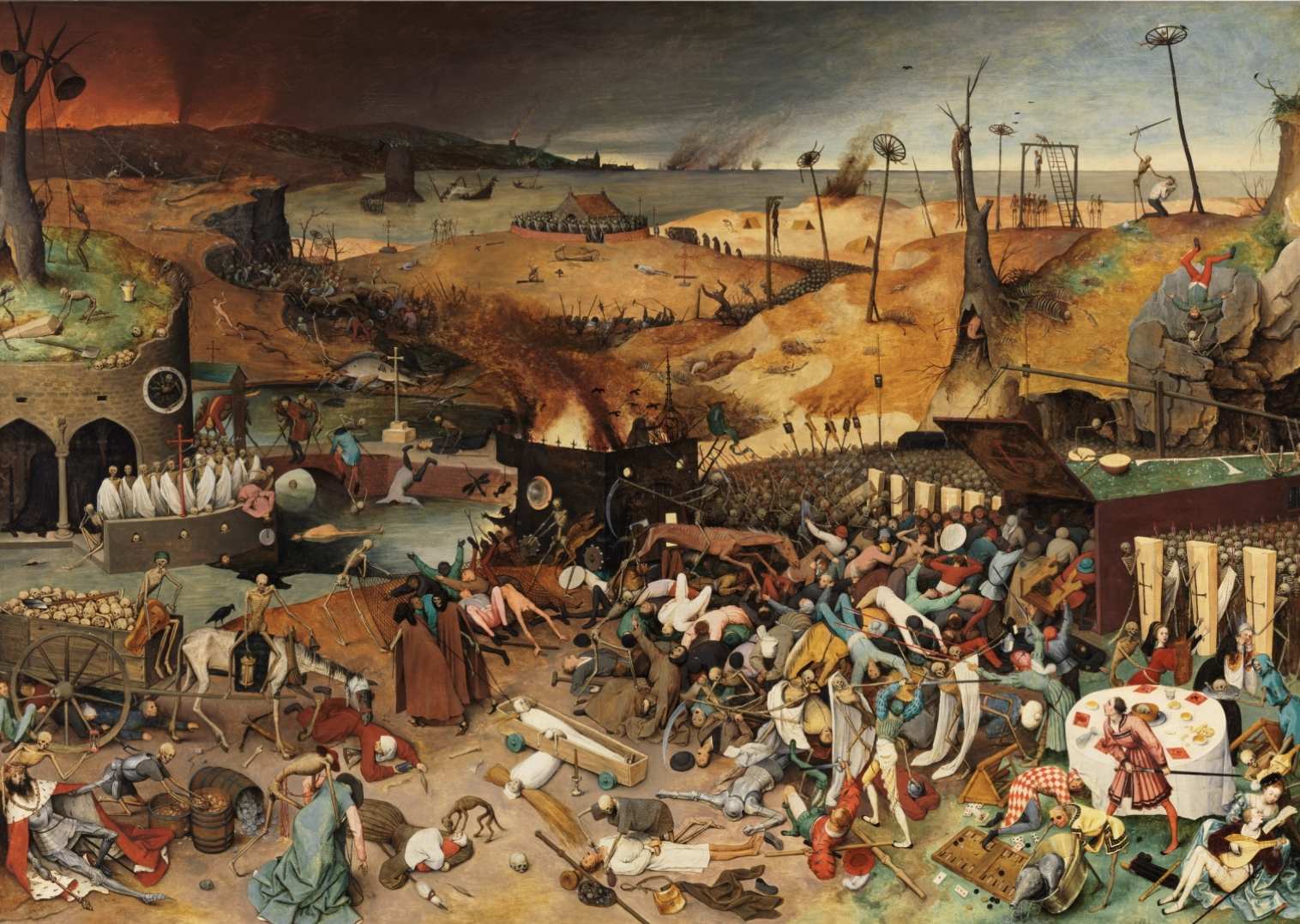
In the mid-16th century, Flemish painter Pieter Bruegel the Elder created one of the most terrifying visions of human existence: The Triumph of Death. The painting covers every inch of the canvas with skeleton armies, burning villages, and humans dragged to their inevitable doom. Unlike religious frescoes offering the hope of salvation, Bruegel’s vision offers no escape—death conquers all.
Unveiling the Secrets
This chilling panorama recalls the same haunting aura in Böcklin’s Isle of the Dead, where viewers are forced to face mortality without consolation. While Michelangelo’s Last Judgment still balanced terror with the possibility of redemption, Bruegel denied even that, plunging his audience into pure despair.
Historical Context: Plague, War, and Turmoil
Painted around 1562, The Triumph of Death reflects an era devastated by plague, famine, and religious wars. Bruegel lived in the Spanish-ruled Netherlands, where violence and repression shaped everyday life.

The skeletal armies marching across barren landscapes echoed the recurring outbreaks of plague that erased entire towns. Just as Böcklin’s Plague visualized the hidden terror of disease, Bruegel’s canvas captured a society’s deepest fear: the invisible, unstoppable force of death.
According to Britannica, Bruegel’s genius was his ability to weave social commentary into allegory, making his painting not only a vision of doom but also a mirror of his troubled age.
The Composition: Chaos Without Salvation
Bruegel’s painting is both panoramic and claustrophobic, filled with detail that denies the viewer any rest:
- Skeleton Armies: Thousands of skeletons march with terrifying order, cutting down peasants, nobles, and clergy alike.
- The Burning Horizon: Villages smolder in the distance, signaling that nowhere remains safe.
- The Fall of a King: A crowned monarch is stripped of gold and dragged toward a coffin, proof that wealth and power cannot shield anyone.
- Everyday Disruption: Lovers playing music, peasants enjoying a drink, soldiers resisting—all are interrupted, crushed by death’s inevitability.
- Broken Time: Hourglasses and clocks litter the ground, visual reminders that every life runs out.

Unlike the structured salvation and damnation of Michelangelo’s Last Judgment—as detailed in the Vatican Museums—Bruegel offers no division. In his world, everyone loses.
Symbolism: Death as the Great Equalizer
Bruegel’s central theme is equality in death. Kings, peasants, monks, and soldiers all collapse before the skeletal army.
This blunt symbolism contrasts sharply with the subtle memento mori in Holbein’s Ambassadors, where a distorted skull reminded Renaissance elites of mortality. Where Holbein whispers, Bruegel screams.

The absence of divine judgment in the painting underscores its modernity: Bruegel wasn’t illustrating heaven and hell but the brutal fact that no one escapes mortality.
Reception and Shock
Unlike works such as Fuseli’s The Nightmare, which faced censorship for indecency, The Triumph of Death was not banned. Yet it shocked viewers precisely because it withheld comfort.

The Met Museum emphasizes that Bruegel combined medieval apocalyptic imagery with Renaissance realism. The result was unsettlingly believable—a plausible apocalypse that forced viewers to confront their fragility.
Reading the Details
The painting rewards close inspection:
- Musicians and Lovers: A skeleton interrupts a pair of lovers making music, a cruel reminder that joy is temporary.
- The Rich and the Poor: Both farmers and aristocrats are slaughtered, reinforcing Bruegel’s theme of equality.
- Religious Figures: Monks and nuns fall like everyone else, a critique of the Church’s inability to shield believers from plague and war.
- The Instruments of Time: Broken hourglasses and clocks emphasize that death ignores status and interrupts all plans.
Like Bosch’s enigmatic Garden of Earthly Delights, the canvas is a dense allegory—but Bruegel’s tone is darker, grounded in lived terror rather than symbolic fantasy.
Legacy and Cultural Echoes
Over centuries, The Triumph of Death became one of Bruegel’s most famous works, influencing generations of artists and writers. Its apocalyptic vision resonated with later horrors—wars, pandemics, and disasters.
The painting has often been compared to Goya’s Saturn Devouring His Son, another brutal masterpiece that exposed humanity’s darkest instincts. Both shocked audiences but became landmarks because they confronted truths people feared to admit.
Today, art historians still teach the fresco alongside Michelangelo’s Last Judgment, reminding us of the stark difference: one promised salvation, the other only despair.
Bruegel and the Dance of Death Tradition
Bruegel’s Triumph of Death did not emerge in isolation. It drew heavily from the medieval tradition of the Danse Macabre—the Dance of Death—popular across Europe since the 14th century. These earlier artworks depicted skeletons leading people of all ranks into the grave, reminding audiences of life’s fragility. Yet Bruegel expanded the motif on an epic scale. Instead of a symbolic dance, he created a sprawling battlefield where death overwhelms every aspect of society. In doing so, he updated medieval allegory with Renaissance detail, making the message impossible to ignore.
Why the Painting Still Resonates Today
In the modern world, Bruegel’s vision continues to feel disturbingly relevant. Pandemics, wars, and climate disasters have revived the sense of a fragile human order. The skeletal armies in The Triumph of Death can be read as metaphors for forces beyond our control—disease, technology, or environmental collapse—that level distinctions of wealth and power. Just as viewers in the 16th century confronted plague and political violence, today’s audiences recognize echoes of their own vulnerabilities. The painting’s endurance lies in this timelessness: it speaks as much to our century as it did to Bruegel’s.
Death Without Refuge
Bruegel’s The Triumph of Death is a merciless vision where no power, faith, or wealth offers protection.
- Skeletons march with inevitability.
- Villages burn with no sanctuary left.
- Time itself collapses into broken hourglasses.
Unlike Michelangelo’s fresco, Bruegel gives us no savior. His painting is not theology but confrontation: a reminder that death unites us all.
FAQ: Bruegel’s The Triumph of Death
Q1. When was The Triumph of Death painted?
Around 1562, during a period of plague outbreaks and political unrest in the Spanish Netherlands.
Q2. What does the painting show?
Skeleton armies attacking humanity, destroying villages, and dragging kings, peasants, and clergy alike to death.
Q3. Why is the painting significant?
It rejects divine salvation and portrays death as universal and unavoidable, reflecting the anxieties of 16th-century Europe.
Q4. Where is the painting now?
It is housed in the Prado Museum in Madrid, Spain.
Q5. How does it compare to Michelangelo’s Last Judgment?
While Michelangelo’s fresco divides the saved and the damned, Bruegel denies salvation entirely, making his work darker and more nihilistic.




Leave a Reply