
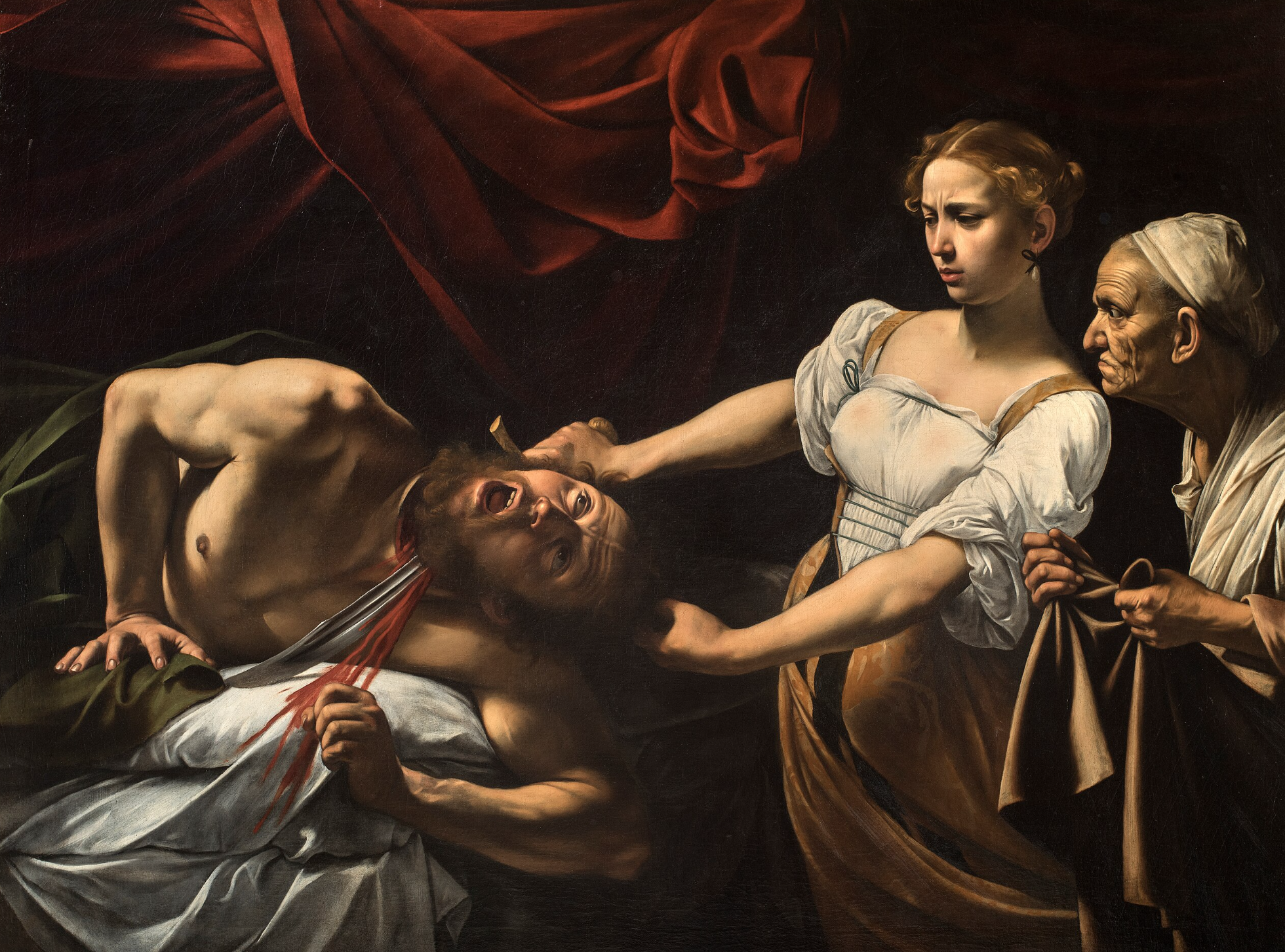
Judith Beheading Holofernes
Before modern cinema mastered shock and moral tension, Caravaggio had already done it with oil and shadow. His Judith Beheading Holofernes (1599) is not just a painting — it’s a moral battlefield frozen in time. The artwork captures the precise moment Judith ends Holofernes’ life, balancing horror with divine justice. Like the awakening of moral conscience seen in The Awakening Conscience, Caravaggio’s work forces us to confront the boundaries between purity and sin.
Table of Contents
The Scene of Divine Justice
In the biblical tale, Judith, a Jewish widow, seduces and decapitates the Assyrian general Holofernes to save her city. Caravaggio’s portrayal strips away heroism, revealing both disgust and determination on her face.
Her hesitant grip echoes the emotional duality explored in Holbein’s The Ambassadors, where beauty conceals moral complexity. The painting today rests in the Galleria Nazionale d’Arte Antica in Rome, where its unsettling blend of faith and violence continues to draw crowds seeking both art and absolution.

Light and Shadow as Moral Theater
The artist’s use of chiaroscuro — dramatic contrasts between light and darkness — defines this scene. The candle-like glow across Judith’s face transforms the act of murder into divine illumination. It’s a visual sermon: light reveals truth, while darkness hides guilt. This interplay of illumination and fear is also evident in Munch’s Anxiety, where psychological turmoil emerges from the shadows themselves.

Caravaggio’s mastery of light reshaped Baroque painting and inspired cinematic realism. Today’s filmmakers — from Scorsese to Coppola — still draw from his contrast-heavy aesthetic. The technique’s broader history is beautifully detailed by the Tate Museum’s essay on chiaroscuro.
The Psychology of Violence
Unlike his Renaissance predecessors, Caravaggio doesn’t glorify Judith’s act. He captures the moment of hesitation, her brows furrowed in both pity and resolve. She’s both executioner and savior — an image of conflicted righteousness.
That internal split recalls The Two Fridas, where Frida Kahlo paints her dual selves — one loving, one bleeding — to express emotional fragmentation.
Similarly, Caravaggio paints the psychological cost of divine action. For him, violence is not just spectacle but self-awareness. His realism anticipates the empathy later seen in Artemisia Gentileschi’s own Judith Slaying Holofernes, preserved in the Uffizi Gallery.
The Silent Witness – Judith Beheading Holofernes
Beside Judith stands an elderly maid, her wrinkled face devoid of pity. She watches, detached, perhaps as a stand-in for Judith’s future self. Caravaggio often used such figures to embody consequence — a reminder that every act of courage carries regret.
This juxtaposition of innocence and experience is also central to The Sleeping Gypsy, where peace coexists with silent danger.
Art historians see this composition as a moral allegory of human frailty. The National Gallery’s analysis of Baroque symbolism points out that such figures often serve as mirrors of conscience — a recurring theme across Caravaggio’s work.
Blood, Faith, and Redemption – Judith Beheading Holofernes
The splattering blood horrified 17th-century audiences, yet for Caravaggio, it symbolized purification through pain. His realism wasn’t gratuitous; it was spiritual anatomy — revealing truth in the flesh. Judith’s blade becomes an instrument of justice, echoing the Catholic notion that sin must be cleansed through sacrifice.
This spiritual violence reflects a Rome dominated by the Counter-Reformation, where art became a tool of moral persuasion. The Khan Academy’s overview of Baroque art notes how painters like Caravaggio transformed religious themes into emotionally charged visual theology.
Rome in 1599: Between Faith and Fear
At the time of its creation, Rome was a paradox — both a city of piety and corruption. Caravaggio himself lived among thieves and courtesans while painting scenes of sainthood and redemption. That dual existence bleeds into Judith Beheading Holofernes, where divine purpose and human doubt share the same frame.
Much like the moral revelation in The Awakening Conscience, Judith’s act represents humanity’s desperate attempt to reclaim virtue in a world consumed by deceit. The painter turns this private moment of faith into public judgment.
Legacy and Modern Resonance
Centuries later, Caravaggio’s influence stretches from baroque altarpieces to noir cinema. His fearless realism shaped Rubens, Rembrandt, and even photographers who chase truth in imperfection. His moral tension continues to inspire contemporary artists exploring guilt and grace.
That same haunting realism appears in Munch’s Anxiety, where human emotion becomes landscape. As Caravaggio.org documents, his lighting and composition techniques still guide visual storytelling today.
The Final Cut – Judith Beheading Holofernes
Caravaggio’s Judith Beheading Holofernes is not a story of violence, but of revelation. It asks: Can beauty coexist with horror? Can righteousness be born from blood? Through shadow and light, Judith becomes a mirror for our own moral awakening — poised forever between fear and faith.
Just as The Two Fridas exposed dual identity, Caravaggio revealed the soul’s conflict under divine scrutiny. His message remains timeless: in confronting darkness, we discover what kind of light we truly carry.
The Turbulent Genius: Caravaggio’s Life Behind the Brush
Michelangelo Merisi da Caravaggio was not merely a painter — he was a paradox of brilliance and chaos, a man whose art and life blurred into one dramatic performance. Born in Milan in 1571, Caravaggio rose from obscurity to become one of the most revolutionary figures in European art. His name became synonymous with chiaroscuro, the technique of using violent contrasts of light and shadow to reveal the moral tension within human souls. Yet, his genius was inseparable from his darkness. Caravaggio lived as fiercely as he painted — impulsive, restless, and dangerously alive.
Before creating Judith Beheading Holofernes (1599), Caravaggio had already made waves in Rome with paintings that broke every rule of Renaissance decorum. While others idealized saints and heroes, he painted ordinary people — street beggars, courtesans, and drunks — and transformed them into sacred figures. His models had dirt under their nails and scars on their faces. To the church elite, this realism was scandalous; to the people, it was revelation. Caravaggio saw holiness in imperfection. His Judith, with her trembling hand and conflicted gaze, became the embodiment of that belief — a human soul torn between sin and salvation.
Caravaggio’s life mirrored the violence of his paintings. He carried a sword, got into constant brawls, and was once accused of killing a man named Ranuccio Tomassoni after a gambling dispute. Forced to flee Rome, he wandered through Naples, Malta, and Sicily — painting masterpieces in exile while living under threat of imprisonment and revenge. During those years, his art grew darker, more introspective, and more tragic. His use of light no longer symbolized divine revelation alone; it became the flicker of guilt, the last breath before redemption.
The power of Caravaggio’s Judith Beheading Holofernes lies precisely in this duality — it is both confession and performance. Judith’s moral dilemma mirrors the painter’s own search for grace amid violence. The same hand that painted divine mercy had also taken a life. It is as if Caravaggio painted his own trial — light against shadow, faith against fear.
Despite his turbulent past, Caravaggio’s influence transcended his reputation. He reshaped Baroque art by rejecting idealism and embracing emotional truth. His realism inspired countless artists, from Artemisia Gentileschi to Rembrandt, and his cinematic use of light continues to influence film and photography today. He died mysteriously in 1610 at the age of 38, likely from illness or revenge, leaving behind a body of work that changed Western art forever.
To understand Judith Beheading Holofernes (1599) is to understand Caravaggio himself — a man who painted faith through sin, redemption through blood, and light through darkness. Every brushstroke was confession, and every shadow, a reminder that even in chaos, truth can still shine.
FAQ
Q1. What is the meaning behind Caravaggio’s Judith Beheading Holofernes?
It depicts divine justice — Judith’s moral act of killing Holofernes to save her people.
Q2. Why was it shocking at the time?
The painting’s brutal realism and emotional intensity defied the idealized beauty of Renaissance art.
Q3. Where can Judith Beheading Holofernes be seen today?
At the Galleria Nazionale d’Arte Antica in Rome.
Q4. What artistic technique defines it?
Caravaggio’s chiaroscuro, blending light and darkness to dramatize faith and emotion.
Q5. How has it influenced modern art?
It shaped Baroque realism and cinematic aesthetics, inspiring artists and filmmakers worldwide.




Leave a Reply