
A Still Frame of Betrayal
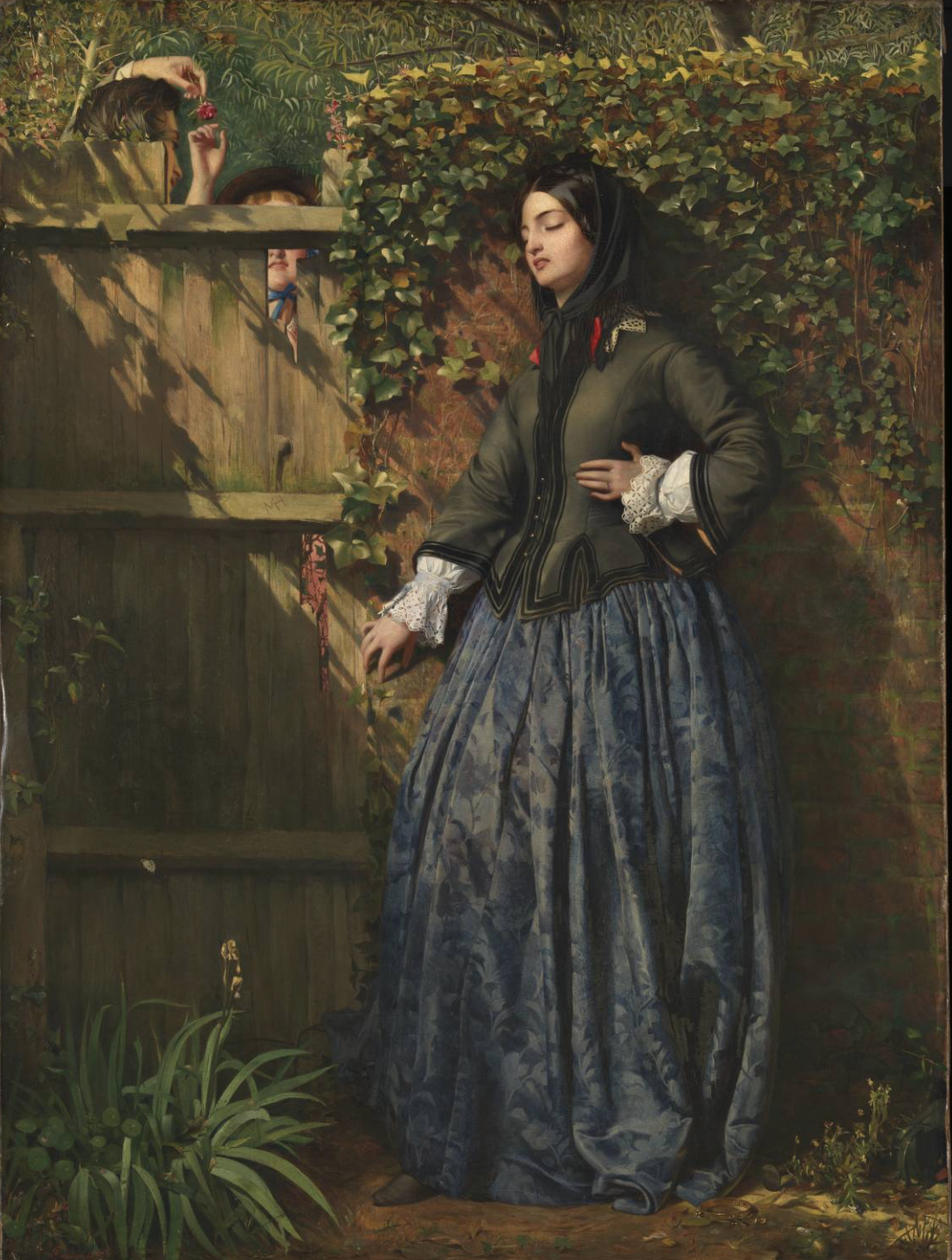
Philip Hermogenes Calderon’s The Broken Vows (1856) isn’t a loud painting. It doesn’t scream betrayal or despair. Instead, it whispers.
A woman leans against a stone wall, her face turned away from the viewer, frozen in a moment between realization and collapse. Behind her — through an ivy-covered arch — another couple stands in secret conversation. Their bodies lean closer than they should.
This isn’t just a scene of heartbreak; it’s the moment when a soul learns the difference between love and illusion.
Like the haunted emotion of The Outcast (1851), Calderon’s work speaks to the moral and emotional rigidity of Victorian society. Love here is not freedom — it is a vow, a chain, and when it breaks, everything unravels in silence.
Table of Contents
Even the Tate Britain curators describe The Broken Vows as a “study in emotional restraint,” a reminder that art doesn’t always shout to move us — sometimes, it only needs to breathe.
You can read more about Calderon’s contemporaries and the Pre-Raphaelite movement’s moral realism through the archives of the Victoria and Albert Museum or the symbolic essays by The British Library.
Each helps us understand why The Broken Vows meaning still resonates: because we all know the pain of believing in something eternal that quietly ended.
The Story Beneath the Surface
Calderon doesn’t give us words, only symbols. The ivy that clings to the wall represents eternal love — but its placement around the archway is deliberate. Ivy is evergreen, but here, it becomes ironic: a symbol of permanence in a world where nothing lasts.

The woman’s hand rests on the wall as if she needs it to stand. The wall is her last source of strength — cold, heavy, unmoving — much like the truth she’s just discovered.
She doesn’t cry. She doesn’t confront. She simply turns away.
It’s a masterclass in restraint — heartbreak rendered in stillness.
Much like Holman Hunt’s The Awakening Conscience, Calderon uses light and composition to externalize emotion. The scene is drenched in a warm but unforgiving sunlight, as if truth itself has burned through illusion.
💔 The Symbolism of Stillness
| Symbol | Meaning | Emotional Weight |
|---|---|---|
| Ivy | Faithfulness, turned to irony | Love that clings even when it’s dying |
| Archway | Passage between fidelity and betrayal | The threshold of truth |
| Sunlight | Revelation, painful awareness | When clarity becomes cruelty |
| Her hand on the wall | Seeking balance amid collapse | Fragile dignity holding despair |
The contrast of light and shadow is essential. Calderon lets the truth shine literally — the sun highlights the betrayal in the background, while the woman herself remains half in shadow.
The message is clear: truth always reveals itself, but never without wounding.
Love, Morality, and Victorian Restraint
In Victorian England, art often served as a mirror of moral expectation. Love wasn’t only personal; it was a duty, a vow — and to break it was to rupture social order.
Calderon, however, humanizes the consequence. He doesn’t moralize; he empathizes.

In that sense, The Broken Vows aligns with the emotional realism found in Judith Beheading Holofernes (1599), another painting that explores the collision of power, virtue, and defiance — though through far darker imagery. Both works ask:
“What happens when a woman finds strength in pain?”
The answer, for Calderon, is silence.
His heroine is not a victim in hysteria but in awareness — the quiet kind of heartbreak that defines maturity.
The betrayal she witnesses is social death, but she endures it with composure.
The Art of Dignified Grief
In The Broken Vows, Calderon resists drama. There’s no chaos, no tears — just the moment before everything shatters.
It’s the same emotional cadence we find in Ilya Repin’s They Did Not Expect Him (1888) — a return, a confrontation, and the unbearable tension between love and memory.
Both paintings rely on subtext rather than spectacle.
They ask the viewer to feel rather than to judge.
This quietness is what makes The Broken Vows timeless. It doesn’t belong only to 19th-century England; it belongs to anyone who has ever realized that love sometimes ends long before goodbye is spoken.
A Woman Between Worlds
The ivy arch divides two emotional realities: behind it, deceit; before it, revelation.

Calderon deliberately situates his heroine in between — trapped at the threshold. She’s both inside and outside of love, both believer and mourner.
The pose recalls classical sculpture — a figure of grace confronting the collapse of her own mythology.
Her broken vow isn’t only her lover’s infidelity — it’s the collapse of faith in the story she believed her life would be.
Connection to Other Symbolic Works
The Victorian Pre-Raphaelite era thrived on moral allegory wrapped in visual beauty. Calderon’s painting shares DNA with other works exploring moral fracture:
- In The Awakening Conscience, the woman realizes her sin in mid-song — awareness as salvation.
- In The Outcast (1851), shame and exile replace speech.
- And in the dark allegory 5 Dark Secrets: Hitler & Isle of the Dead, death and obsession are eternal partners.
These works, like The Broken Vows, are less about morality and more about emotional revelation — the precise moment when the mask of innocence falls.
Calderon’s Legacy
Philip Hermogenes Calderon was part of the early Pre-Raphaelite movement that sought sincerity in emotion and moral realism in art.
Born in 1833, he became known for blending romantic beauty with moral intensity — crafting visual poetry from silence.
The Broken Vows stands among his most enduring works precisely because it resists time.
The faces, clothes, and architecture may belong to 1856 — but the feeling? Eternal.
Why It Still Resonates
Because betrayal hasn’t changed.
Because heartbreak still happens quietly.
Because dignity — even when shattered — remains the truest act of self-preservation.
Calderon’s painting teaches that heartbreak doesn’t always need witnesses to be real.
Sometimes the deepest pain is endured privately, without a scream —
just a breath, a step back, and a silence that echoes through centuries.
“Love doesn’t always die in fire.
Sometimes it fades — like sunlight through ivy.”
🖼️ Artwork Details
- Title: The Broken Vows
- Artist: Philip Hermogenes Calderon
- Year: 1856
- Medium: Oil on Canvas
- Style: Victorian Realism / Pre-Raphaelite Influence
- Current Location: Tate Britain, London
Bottom Line – The Dignity of Pain
Calderon’s The Broken Vows is not about betrayal — it’s about what follows it: silence, composure, and the quiet rebuilding of the self.
While other Victorian artists moralized love, Calderon humanized heartbreak. He turned pain into poetry.
In her stillness, the woman refuses to collapse; she becomes her own sanctuary.
Her hand on the wall isn’t just a gesture of weakness — it’s the physical embodiment of endurance.
She holds herself together, even as her world unravels behind her.
This same emotional architecture — beauty built from brokenness — connects The Broken Vows to other symbolic masterpieces like Fuseli’s “The Nightmare,” Millais’ “The Vale of Rest,” and the haunting allegories explored by The Metropolitan Museum of Art.
Each shows how art transforms suffering into stillness — a form of survival.
In the end, Calderon reminds us that pain doesn’t erase love. It refines it.
The ivy still clings to the wall not because it’s naïve, but because it’s stronger than fire.
“Some vows are broken by lies,
others — by truth too bright to bear.”
And that’s the eternal truth behind The Broken Vows meaning:
not all endings are loud, and not every silence is empty.
Some silences — like hers — become art itself.
FAQ
What is the meaning of The Broken Vows (1856) by Philip Hermogenes Calderon?
The Broken Vows symbolizes betrayal, silence, and the fragility of love. Calderon captures the exact moment when a woman realizes her lover’s infidelity — not through drama, but through dignified stillness. The ivy and archway represent broken promises and lost faith.
What does the ivy represent in The Broken Vows?
The ivy symbolizes eternal love and loyalty, but in this painting, it turns ironic. It becomes a reminder of promises that once meant forever, now decaying under the weight of betrayal.
How does Calderon’s painting reflect Victorian morality?
In Victorian society, love was bound to moral duty. Calderon, however, shows the human side of heartbreak — not judgment, but empathy. The woman’s silence reflects strength and awareness, not shame.
Where is The Broken Vows located today?
The painting is part of the Tate Britain collection in London, celebrated as one of Calderon’s most emotionally powerful works from the Pre-Raphaelite-inspired Victorian period.
What is the style of The Broken Vows?
The painting reflects early Pre-Raphaelite influence — realistic detail, symbolic objects, and emotional sincerity. It blends moral allegory with intimate emotion, creating a timeless study of human truth.




Leave a Reply to The Meeting on the Turret Stairs (1864) – Love in Its Final BreathCancel reply