
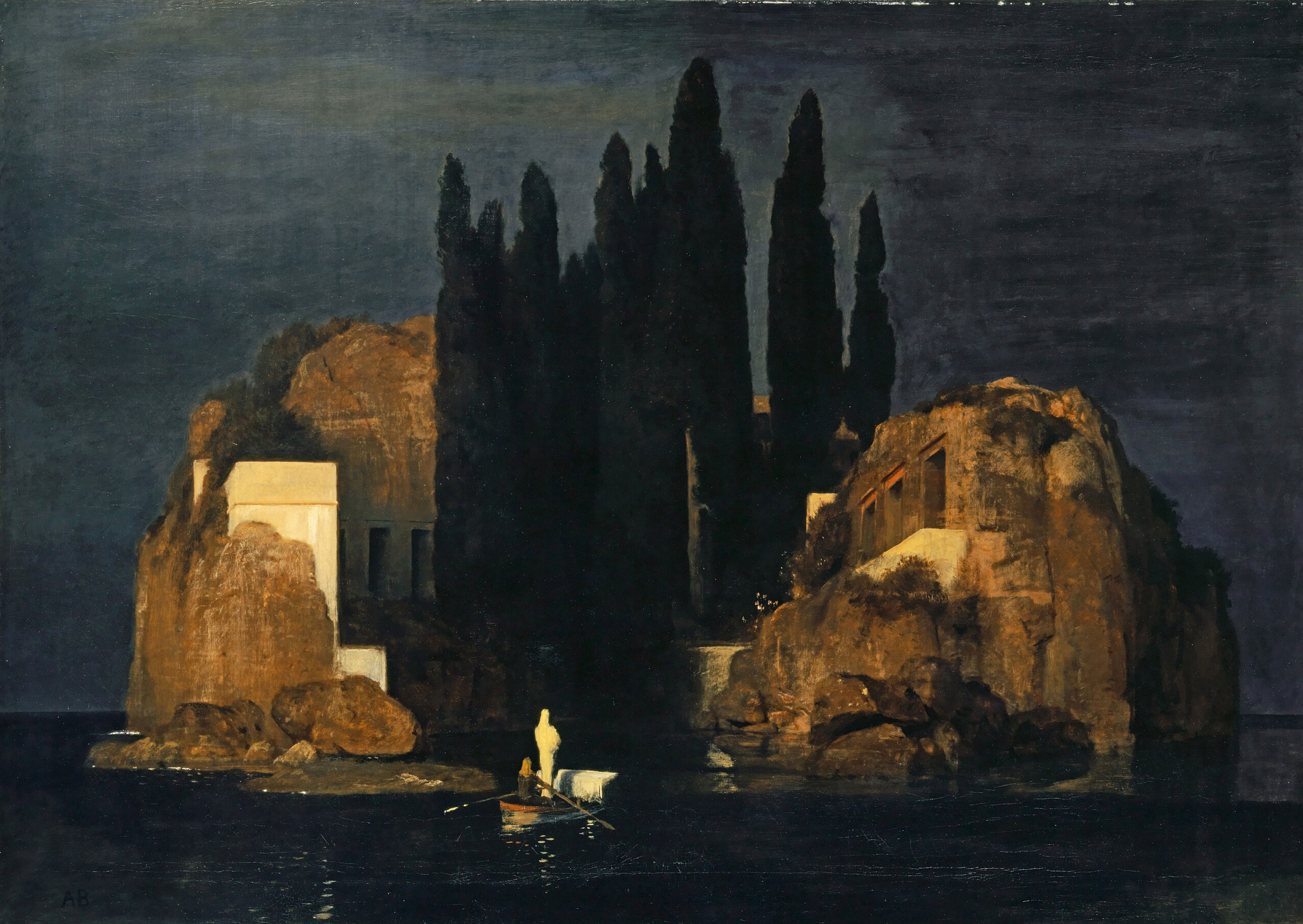
For more than 200 years, a single painting has captivated philosophers, composers, and even dictators. Adolf Hitler reportedly hung it in his chambers. Sergei Rachmaninoff turned it into music. Nietzsche called it unforgettable.
How could one work of art grip such different minds with equal intensity? Stay with me, and we’ll uncover the five dark secrets behind Arnold Böcklin’s Isle of the Dead, one of the most haunting paintings ever created.
Guide to the 5 Dark Secrets
Introduction: A Painting That Haunted Generations
Arnold Böcklin (1827–1901) was a Swiss Symbolist painter whose masterpiece Isle of the Dead (Die Toteninsel) became more than just a painting—it became a cultural phenomenon.
First painted in 1880, Böcklin created five versions. One of the most famous, the New York version housed at The Met Museum, captures the eerie stillness that defined the Symbolist movement.
The imagery is unsettling: a small boat gliding over black waters, carrying a coffin and a shrouded figure toward a rocky island crowned with cypress trees. This simple scene resonated so deeply that prints spread across Europe, and it became one of the most reproduced artworks of its time.
1. Death Takes Center Stage
Unlike allegorical paintings where death is hidden in symbols, Isle of the Dead puts mortality front and center. The coffin in the boat, the mournful cypress trees, and the eerie stillness of the water all point directly to death.

In an age marked by epidemics, wars, and social upheaval, this was not just art—it was a meditation on mortality itself. For ordinary Europeans, the painting was a mirror of their anxieties. For Hitler, it was a grim reflection of his obsession with death and destiny.
Just as Hans Holbein hid a skull in The Ambassadors, Böcklin stripped away metaphor and forced viewers to look directly into the face of death.
2. A Magnet for Philosophers and Composers
The painting wasn’t just Hitler’s obsession. It inspired some of the greatest minds of its time.

Hitler was said to have kept Böcklin’s Isle of the Dead in his personal space, revealing his fascination with Symbolism and death imagery.
- Friedrich Nietzsche admired its somber mood, seeing in it the weight of eternity.
- Vladimir Nabokov, the novelist, described it as one of Symbolism’s most evocative works.
- Sergei Rachmaninoff was so struck by it that he composed his 1909 symphonic poem Isle of the Dead, written in 5/8 time to capture the boat’s rowing rhythm.
The fact that a single painting could move a dictator, a philosopher, a novelist, and a composer shows its universal power.
3. From Popular Masterpiece to Dark Legacy
In the late 19th and early 20th centuries, Isle of the Dead was everywhere. Prints and postcards circulated across Europe. For many households, it was a contemplative image—solemn, mysterious, but not threatening.

That changed when Hitler embraced it. He saw in the painting permanence, destiny, and the vision of an eternal empire. What was once a universal meditation on death became forever linked to dictatorship and destruction.
This is similar to how Fuseli’s The Nightmare transformed over time from a Gothic curiosity into a cultural icon of unease and terror. Böcklin’s work, too, shifted from meditation to menace.
4. The Symbolism of the Island
The island itself is a potent symbol. The narrow passageway through its rocks suggests a gateway into eternity. The towering cypress trees—traditional emblems of mourning—reinforce the funerary atmosphere.

For Symbolist painters, this was poetry in paint. For Nietzsche, it hinted at eternal recurrence. For Hitler, it was a metaphor for permanence. For art historians today, it remains a touchstone of late Romanticism and Symbolism, studied in depth by resources such as Smarthistory.
The painting’s strength lies in its ambiguity—it can mean different things to different people, which is why it inspired such a wide range of admirers.
5. A Painting That Still Haunts Us Today
Two centuries later, Isle of the Dead continues to fascinate. Exhibitions draw crowds. Discussions of “the scariest paintings in the world” almost always include it.
For Hitler, it was obsession. For Rachmaninoff, it became music. For Nietzsche, it symbolized philosophy. And for us, it is still a mirror—forcing us to think about death, destiny, and what we leave behind.
Even now, we are still rowing toward Böcklin’s island.
Five Dark Secrets Revealed
Arnold Böcklin’s Isle of the Dead is one of the most haunting works of Symbolist art.
- It places death at the forefront.
- It captured philosophers and composers alike.
- It shifted from beloved image to dark legacy under Hitler.
- It embodies powerful symbolism in its island and cypresses.
- It continues to haunt us today.
Few works of art have touched so many people, in so many different ways. That is why Isle of the Dead is not just a painting, but a cultural myth, forever shadowed by history’s darkest figures.
FAQ
Q1. Who painted Isle of the Dead?
It was painted by Swiss Symbolist artist Arnold Böcklin in 1880, with five versions created between 1880 and 1886.
Q2. Where is Isle of the Dead today?
Different versions are housed in Kunstmuseum Basel (Switzerland), Alte Nationalgalerie in Berlin, and The Metropolitan Museum of Art in New York.
Q3. Why did Hitler like this painting?
Hitler admired its somber imagery, interpreting it as a symbol of permanence, destiny, and empire. He reportedly hung a version in his personal quarters.
Q4. Why did Rachmaninoff compose music about it?
Sergei Rachmaninoff was so inspired by the painting’s mood that he wrote his symphonic poem Isle of the Dead in 1909, capturing the rowing boat’s rhythm in music.
Q5. Why is Isle of the Dead considered disturbing?
Because it confronts viewers with death directly, while leaving its meaning ambiguous—peaceful to some, terrifying to others.
If you’re fascinated by dark masterpieces, you may also want to explore Goya’s terrifying Saturn Devouring His Son, often ranked among the Top 3 Scariest Paintings in the World: Goya’s Saturn Devouring His Son.




Leave a Reply